
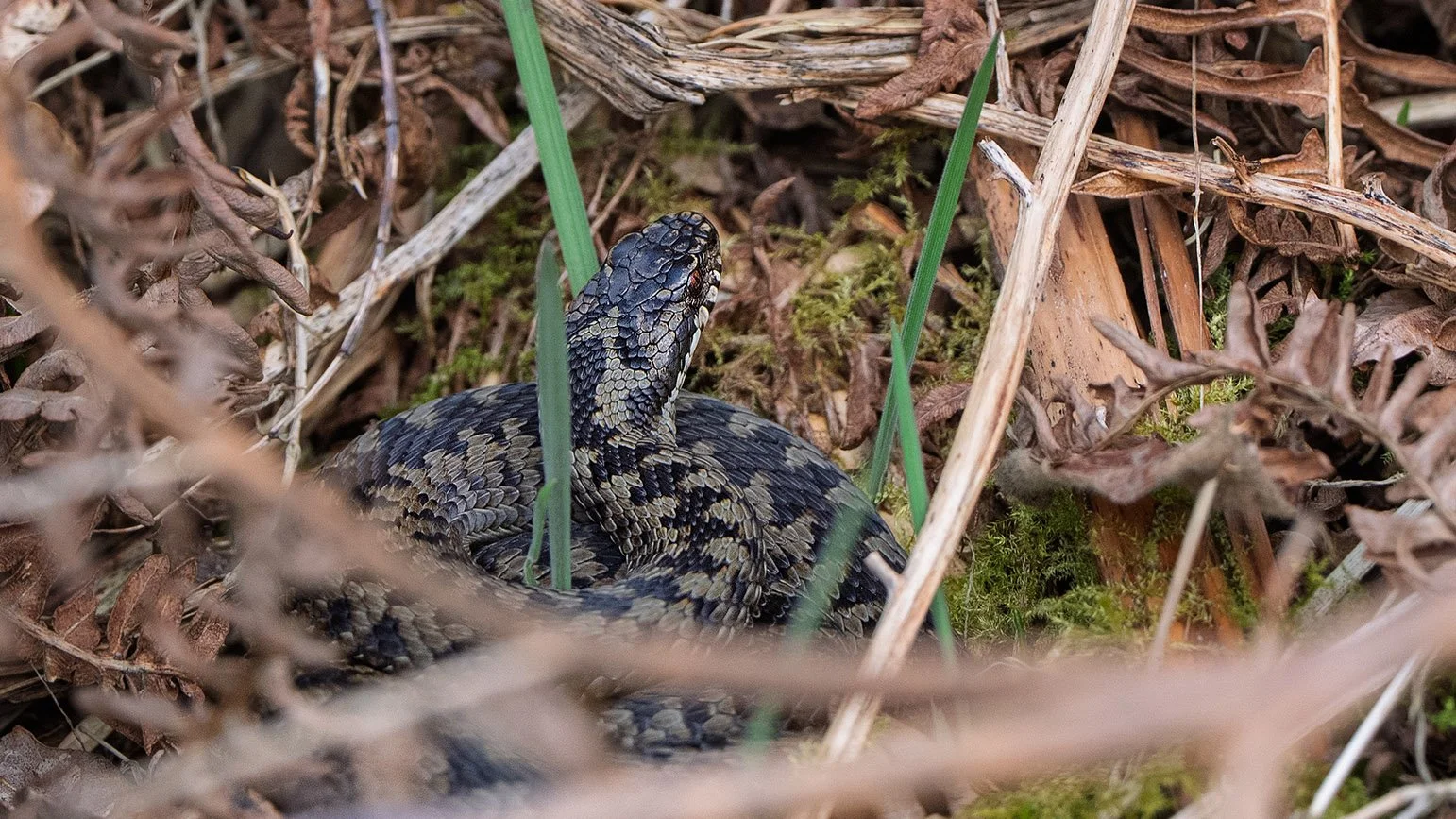
Adders — A heartbeat hidden beneath leaves
Field Notes from the Hillside
“Observations from on the hillside – wildlife photography in Scotland.”
Field Notes: Adders
Drama vs Depth
There’s a certain reputation that follows adders.
It tends to lean towards danger. Sudden movement. Something to be wary of.
But spend time with them — properly, quietly — and that idea fades quickly.
There’s very little drama here.
What you find instead is restraint. Stillness. A kind of quiet efficiency in how they exist within the landscape. They don’t announce themselves. They don’t need to.
Most of the time, they’re not seen at all.
And when they are, it’s rarely because they’ve revealed themselves —
it’s because someone has slowed down enough to notice.
Story beneath the leaves
Early spring.
The ground is still holding the cold of winter, but the light has shifted. Just enough warmth reaches the edges — banks, bracken, rough grass — and something begins to return.
This is where adders appear.
Not in obvious places, but in the in-between. Edges of paths, breaks in vegetation, quiet corners that catch the first sun.
At first, there’s nothing.
Then something doesn’t quite fit. A line, a curve, a pattern that feels slightly out of place.
And then it resolves.
Not movement. Not behaviour. Just presence.
An animal perfectly matched to its surroundings, revealed only by patience.
Cool air. Stillness.
That kind of morning where the landscape feels like it’s holding its breath.
Light comes in low, picking out texture rather than colour — dried stems, moss, the soft tangle of last season’s growth.
You move slower without thinking about it.
Every step feels like it matters.
And when you stop — properly stop — the place begins to open up.
Look out for…
Often encountered on south-facing banks, rough grassland, and moorland edges
Most visible during early spring basking periods
Highly camouflaged — patterns mirror surrounding vegetation
Usually still; movement is subtle and deliberate
Presence often revealed through pattern recognition rather than motion
Feel of the day
Finding an adder isn’t a moment of action.
It’s a moment of realisation.
You’re already close. Closer than you think.
And then, gradually, your eyes adjust.
The shape separates from the ground. The pattern becomes clear. The head lifts slightly.
Nothing has changed — except your awareness.
That’s what stays with you.
Not the sighting itself, but the shift in how you see.
Once you’ve noticed one, you begin to understand how many you’ve walked past before.The most reliable window is early spring (March–April).
After months below ground, adders emerge to bask, taking advantage of low, gentle sunlight. Vegetation is still sparse, making them easier — though never easy — to see.
As the season progresses:
Activity increases
Visibility decreases
Encounters become more fleeting
A smaller window returns in early autumn, but nothing matches the quiet clarity of spring.
The Experience & Seasonality
Conservation
The Adder (Vipera berus) is the UK’s only native venomous snake, and despite its reputation, it is a shy and largely unseen species.
Populations in parts of the UK are declining due to:
Habitat loss and fragmentation
Increased disturbance
Misunderstanding and persecution
Encounters are best approached with distance and respect.
If left undisturbed, adders will avoid interaction entirely — slipping back into cover long before they are noticed.
Their presence is a sign of a functioning landscape.
One that still holds enough quiet, enough structure, and enough balance for something this subtle to exist.
Explore More Wildlife Field Notes
If you enjoyed this glimpse into the world of Adders, you’ll find many more stories from Scotland’s wild places throughout the site.
From Atlantic rainforest landscapes to seasonal wildlife encounters, the Wildlife Field Notes section shares observations, photographs and moments from the forests, rivers and hills of Scotland.