
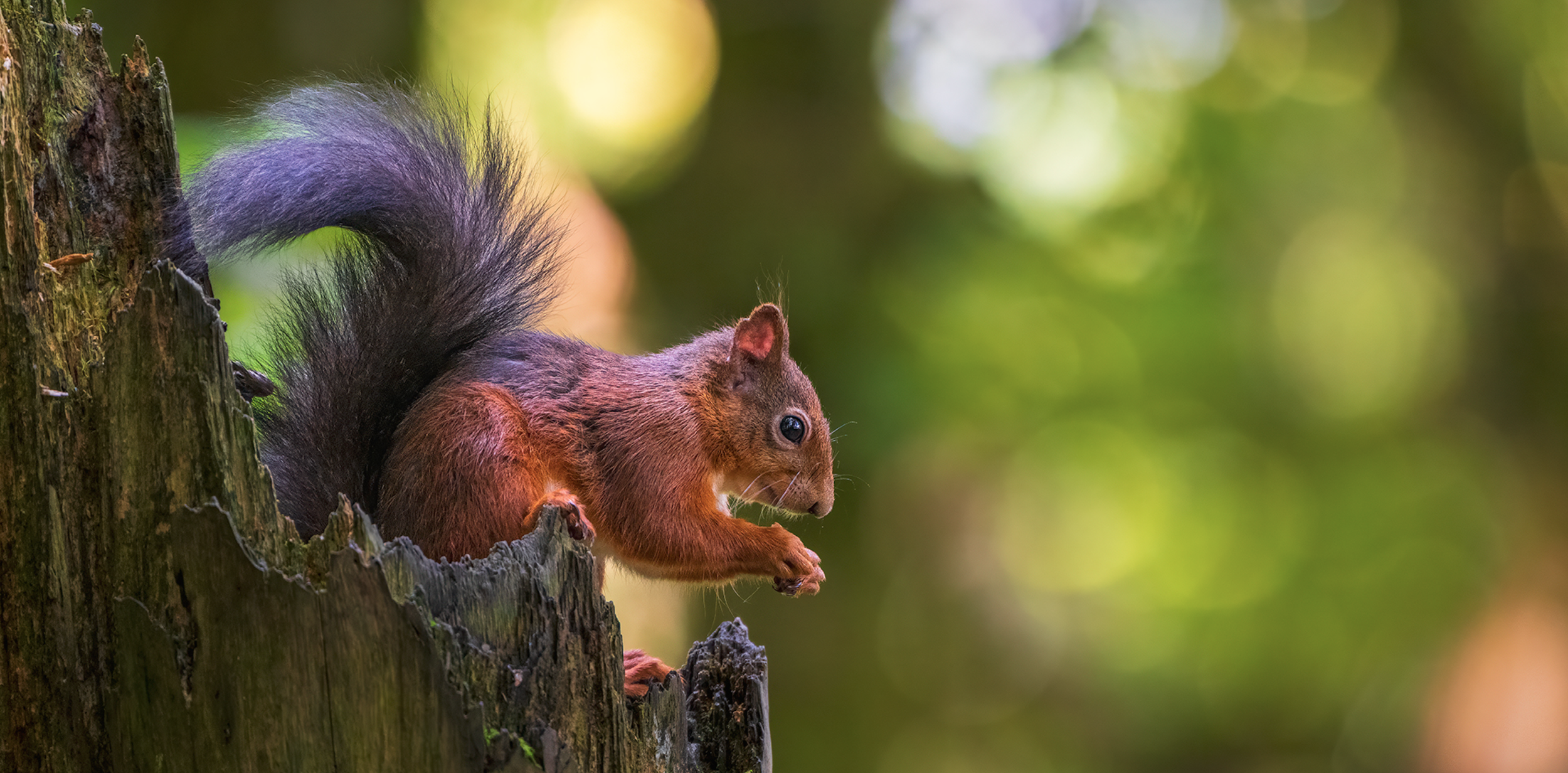
The Secret Life of the
Red Squirrel
A Flash of Rust in the Forest
A Flash of Rust in the Forest
Walk quietly through a Scottish woodland and you might hear it before you see it.
A faint rustle in the branches, the soft fall of pine cone scales drifting down through the trees. Then suddenly — a flash of russet fur racing along a branch before vanishing again into the canopy.
The Eurasian Red Squirrel is one of Scotland’s most charismatic woodland animals, quick, curious and endlessly energetic.
Yet despite their familiarity, red squirrels live much of their lives hidden among the branches.
Scotland’s Native Squirrel
Red squirrels are Britain’s only native squirrel species, once common across the country.
But during the 19th century a new arrival changed their fortunes.
The Eastern Grey Squirrel, introduced from North America, spread rapidly across England and Wales. Larger and more adaptable, grey squirrels compete for food and habitat — and carry the squirrelpox virus, which is fatal to reds.
As a result, red squirrels disappeared from many parts of Britain.
Scotland, however, remains their stronghold.
Today large populations survive in the Highlands, the Cairngorms, Argyll, and many of the country’s conifer forests.
Masters of the Woodland Canopy
Red squirrels are superbly adapted for life in the trees.
Their long bushy tail helps them balance as they leap between branches, sometimes covering gaps of several metres in a single bound.
In winter their most distinctive feature appears: tufted ears, giving them an almost mythical woodland character.
These small mammals spend much of their time gathering and storing food — pine seeds, hazelnuts, berries and fungi — often burying supplies across the forest floor in hidden caches.
Many of these stores are never recovered, quietly helping forests regenerate.
Life in the Drey
A red squirrel’s nest is known as a drey.
I don’t photograph at the Drey - sorry.
The Drey is built from twigs, moss and leaves, these round structures are usually tucked high in the branches of a tree where they offer protection from predators and weather.
From here young squirrels begin their first cautious explorations of the forest, learning the skills that will keep them alive in the woodland canopy.
A Woodland Encounter
For those walking Scotland’s forests, a red squirrel encounter often lasts only seconds.
A movement in the branches.
A curious pause as bright eyes look down from a trunk.
Then another burst of energy as the squirrel disappears through the trees.
But these fleeting moments are often enough to remind us how alive Scotland’s woodlands still are — and how important they remain for the wildlife that depends upon them.
Explore More Wildlife Field Notes
If you enjoyed this glimpse into the world of Red squirrels, you’ll find many more stories from Scotland’s wild places throughout the site.
From Atlantic rainforest landscapes to seasonal wildlife encounters, the Wildlife Field Notes section shares observations, photographs and moments from the forests, rivers and hills of Scotland.