
The Bogie Line
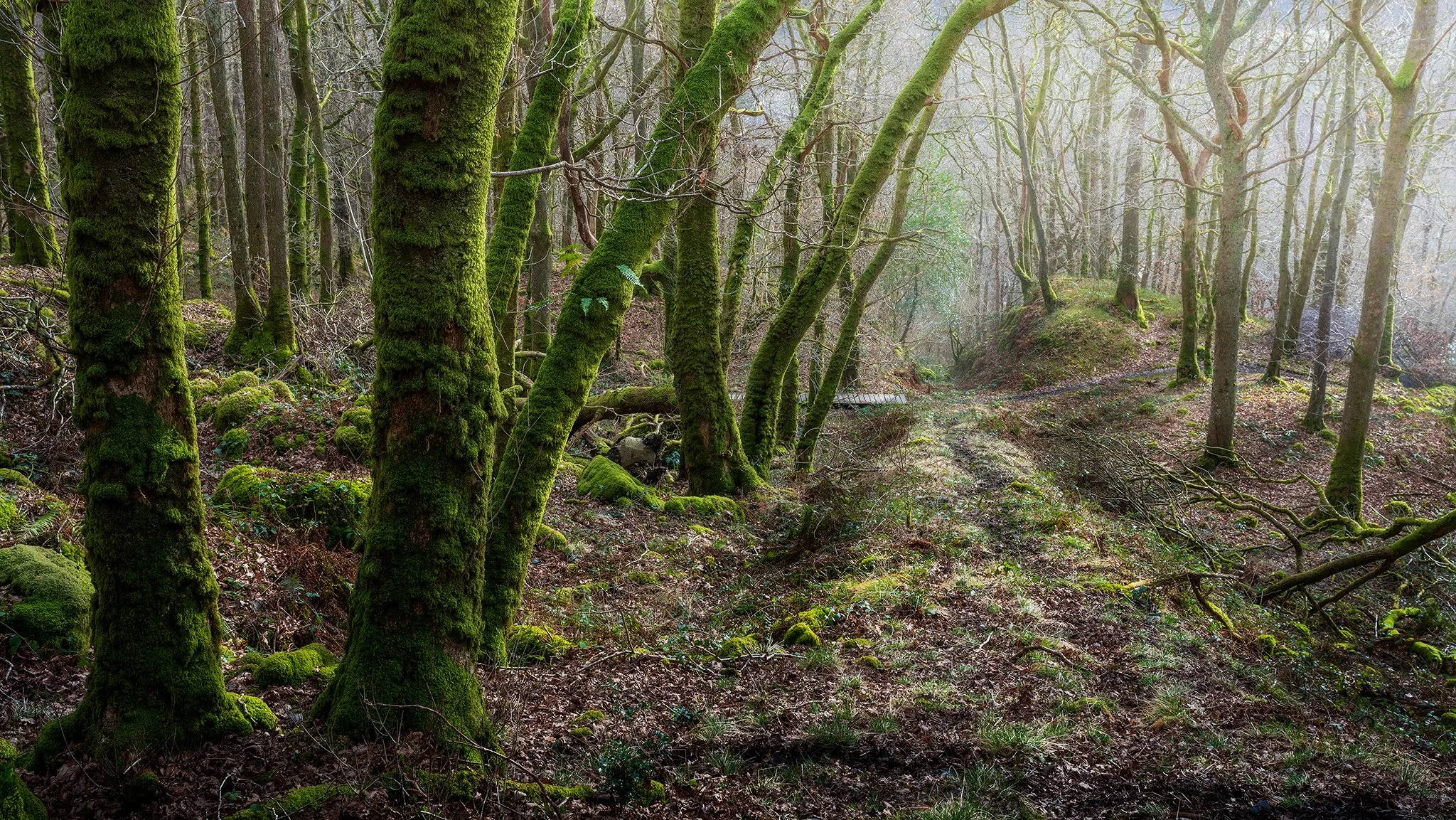
A quiet woodland path where nature has softened the traces of industry and time.
Part of Aberfoyle’s Heritage
Drama vs Depth
Scotland’s landscapes are often celebrated for their dramatic scenery — towering mountains, sweeping glens and rugged coastlines.
Yet some of the country’s most fascinating places are quieter.
Hidden within woodland around Aberfoyle are landscapes that reveal their stories slowly. At first glance these oak woods appear timeless and untouched, part of the ancient Atlantic rainforest that once covered large areas of western Scotland.
But beneath the trees lies another story — one shaped not only by nature, but by the ingenuity and industry of those who lived and worked here.
The Bogie Line is one such story.
The Story Beneath the Trees
In the nineteenth century the hills around Aberfoyle supported small slate quarries supplying roofing materials to nearby towns and villages.
Moving heavy slate down steep woodland slopes presented a challenge. The solution was simple but clever.
A narrow track was constructed through the woods, forming what became known locally as the Bogie Line.
Small wagons carried the slate along this route using a counterbalance system. Loaded wagons descending the hill would pull empty wagons back up the incline — one travelling down while the other slowly climbed.
Gravity did most of the work.
Though the rails themselves have long since disappeared, traces of the route remain visible to those who know where to look.
The faint track, now softened by moss and leaf litter, still runs quietly through the woodland — a subtle reminder of the industry that once shaped this landscape.

The Experience
Walking here is a gentle wander rather than a defined route.
The ground underfoot is soft and damp, hardly surprising after the weather Scotland is so well known for.
Animal paths weave quietly through the woodland.
In places two routes appear clearly: one climbing up the bank following the old railway alignment, the other crossing the forest floor below, winding between the moss-covered trunks.
It is easy to imagine how the line once moved through this landscape, carrying slate through the trees while the surrounding forest carried on much as it does today.
Optional Elements
Woodland like this rewards those who take their time.
Looking closely reveals:
• intricate lichens coating the bark of ancient oaks
• mosses that thrive in the constantly damp air
• fallen branches slowly returning to the forest floor
These details form part of the rich biodiversity that makes Scotland’s Atlantic rainforest so remarkable.
Seasonality
The character of the Bogie Line woodland changes subtly throughout the year.
Spring brings fresh green light and woodland flowers emerging through the leaf litter.
Summer deepens the canopy shade, with thick mosses glowing against the bark of oak and birch.
Autumn introduces warm tones of amber and copper as the woodland floor fills with fallen leaves.
Winter reveals the shape and structure of the forest — twisting trunks, pale lichens and soft light filtering through bare branches.
Each season reveals a different aspect of the woodland’s quiet beauty.
Respecting a Fragile Landscape
Scotland’s Atlantic rainforest is both rare and sensitive.
These woodlands support complex ecosystems that have developed over centuries in Scotland’s uniquely humid western climate.
Protecting them requires careful stewardship.
Small groups help reduce impact.
Paths are chosen thoughtfully.
Sensitive areas are respected and left undisturbed.
The aim is always to experience the woodland without disturbing the delicate balance that allows these habitats to thrive.
Connection leads to conservation.
Enquiry
If you would like to learn more about the landscapes, history and natural heritage of the Trossachs, further information can be found throughout this website.