
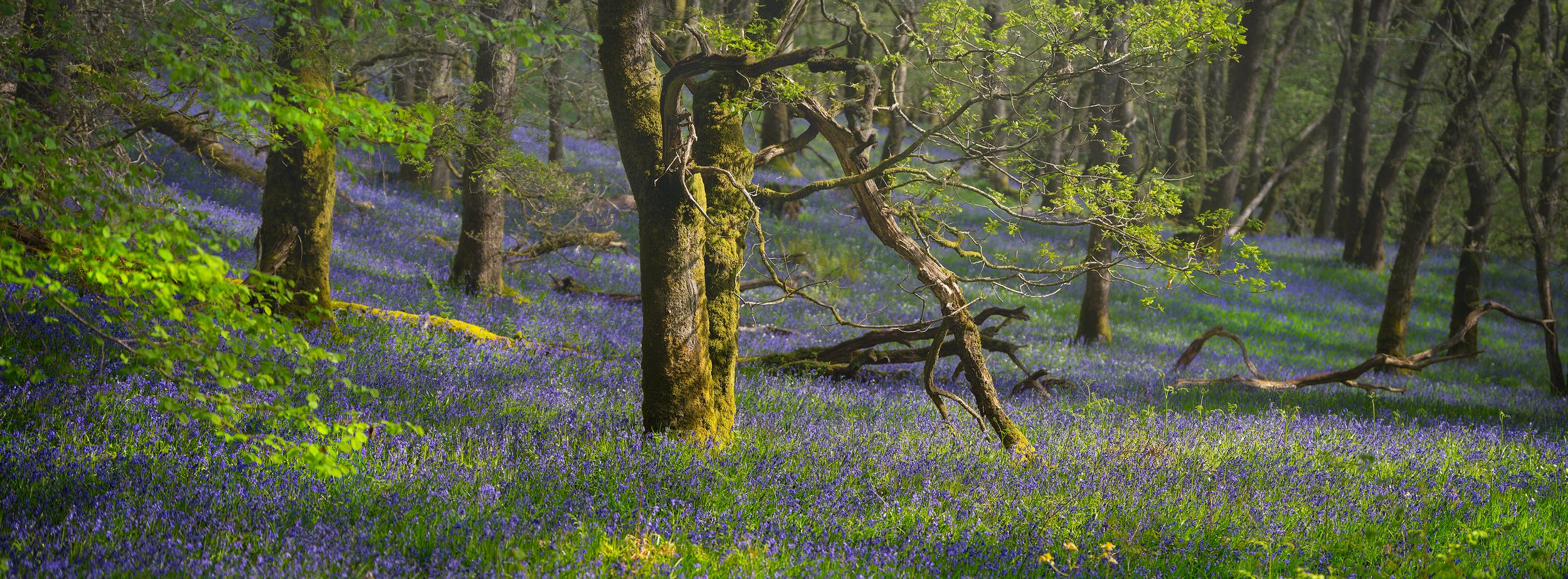
Bluebells in the Atlantic Rainforest
Spring in the Woodlands of Aberfoyle
For a few short weeks each spring, the woodland floor of Scotland’s Atlantic Rainforests become a sea of delicate blue.
Drama vs Depth
Scotland is often associated with dramatic landscapes — towering mountains, deep glens and sweeping moorlands.
Yet some of the country’s most magical moments occur quietly beneath the trees.
In ancient woodlands around Aberfoyle, spring brings a transformation that is subtle yet extraordinary. The forest floor becomes carpeted with bluebells, their delicate colour spreading through the woodland like a soft mist of violet light.
These displays are not simply beautiful; they are a sign of something much deeper.
Bluebells thrive in ancient woodland — places where forests have existed for centuries with relatively little disturbance. Their presence is often an indicator that the woodland itself has a long ecological history.
In these forests, nature reveals its stories slowly.
The Story Beneath the Trees
The oak woods surrounding Aberfoyle form part of Scotland’s temperate Atlantic rainforest, one of the rarest habitats in Europe.
These forests exist because of a unique combination of conditions:
• high rainfall
• mild oceanic climate
• humid Atlantic air
The constant moisture allows mosses, lichens and woodland plants to flourish in remarkable abundance.
Bluebells are one of the most recognisable spring species within this ecosystem.
For a brief period usually from early May, before the oak canopy fully closes, sunlight reaches the woodland floor. Bluebells take advantage of this short window of light, flowering quickly before the shade deepens as the leaves emerge.
The result is one of the most beautiful seasonal displays in Britain’s woodlands.
The Feel of the Day
Early mornings in these woods have a particular atmosphere.
Mist often lingers between the trees, softening the shapes of trunks and branches. As the sun rises, shafts of light filter through the canopy and begin to illuminate the bluebells scattered across the forest floor.
Birdsong fills the woodland — robins, blackbirds and thrushes calling through the quiet air.
The ground is usually damp with dew or overnight rain, and the scent of woodland earth rises gently as the day warms.
In moments like this the forest feels calm, almost timeless.
The Experience
Walking through a bluebell woodland is not a hurried activity.
Paths weave quietly between the trees, sometimes following the gentle routes created by wildlife moving through the forest.
The bluebells themselves are fragile. Their stems bend easily underfoot, so care is needed to avoid disturbing the delicate carpets that have taken years to establish.
Moving slowly through the woodland allows the eye to notice details:
• the way light falls across the flowers
• droplets of dew resting on petals
• insects moving carefully between blossoms
It becomes an experience of observation rather than simply a walk.
The Details of the Woodland
Ancient woodland reveals countless small details to those who look closely.
The bark of the oaks supports intricate communities of moss and lichen.
Fallen branches slowly decay into the soil, returning nutrients to the forest.
Delicate spring flowers emerge alongside the bluebells, including wood anemones and wild garlic.
Together these species create a rich and balanced woodland ecosystem.
Respecting a Fragile Landscape
Atlantic rainforest woodland is both rare and sensitive.
Many of these forests survive only in small fragments scattered across Scotland’s western landscapes.
Protecting them requires careful stewardship.
• We keep groups small
• We tread lightly
• We avoid overused paths
• We prioritise understanding and protection
Connection leads to conservation.
Enquiry
Further information about Scotland’s Atlantic Rainforest landscapes, seasonal woodland events and Field Notes from the forest can be found throughout this website.
Last Word…
The undergrowth will be wet especially early on.
The area is stunning and needs to remain so.
Not just for this year but for the future.
If you look closely into the bluebells you will often notice narrow animal paths where deer move quietly through the woodland. When walking here it is best to follow these routes where possible to avoid damaging the flowers.
I’ve already mentioned what a great place this is, for me it is one of the best places to see Bluebells, we are lucky.
ps.. bring a big memory card and spare batteries, you will need them, and remember lunch and a drink… you might want to stay beyond the time you expected to be here!